
Leadership Development
Subscribe to Newsletter
Confidence and Creativity in the Digital Age: A Personal Journey
Following 11 years in private dental practice, transitioning into full-time academics was challenging on many fronts, but not being technologically savvy required the steepest learning curve. The digital age reshaped not only how education is delivered but also how...

On Cultivating the Wisdom to Lead
In the March 2026 issue of Noteworthy, I argued in this article that the most important work of leadership development is not skill-building but the cultivation of purpose and judgment — the capacity to deliberate wisely about what matters in the service of a...

Financial Literacy as a Leadership Imperative
Financial literacy stands as one of the most critical yet unevenly developed competencies among academic leaders in health professions education. In our professional development work at AAL, we regularly encounter both extremes: the department chair who has never seen...
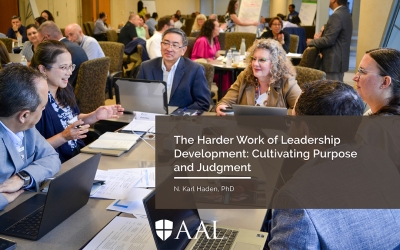
The Harder Work of Leadership Development: Cultivating Purpose and Judgment
Most formal leadership programming focuses on developing competencies — from managing conflict to leading change. No doubt, effective leaders need an ever-growing set of knowledge and skills — tools and practical guidance on how to use them. But for many institutions,...

A Skeptic’s Observations on Leadership
Having just finished another article on leadership, I’m reminded of why I find most modern treatments of the subject uninspiring, uninformed, repetitive, and unoriginal. No matter what color the wrapping, inside the best books and articles on leadership is a similar...

Making Tough Career Choices: 5 Questions to Ask Yourself
Two roads diverged in a yellow wood, And sorry I could not travel both… Robert Frost Last year, during one of our large leadership programs, a participant asked me about a major career choice she faced. In this case, the choice involved leaving her organization and...

Why “Soft” Skills Aren’t Really Soft
Today, emerging leaders will likely have a college degree, technical qualifications (making them theoretically competent to perform the tasks required of them), and relevant work experience—but what about the personal attributes that enable leaders to interact...

What Leaders Can Learn from the “World Happiness Report”
In Chapter 9 of The 9 Virtues of Exceptional Leaders, titled “Hope,” Rob and I devote several paragraphs to discussing the work of Viktor Frankl, a survivor of both Auschwitz and Dachau and the father of logotherapy—a theory founded on the belief that human nature is...