
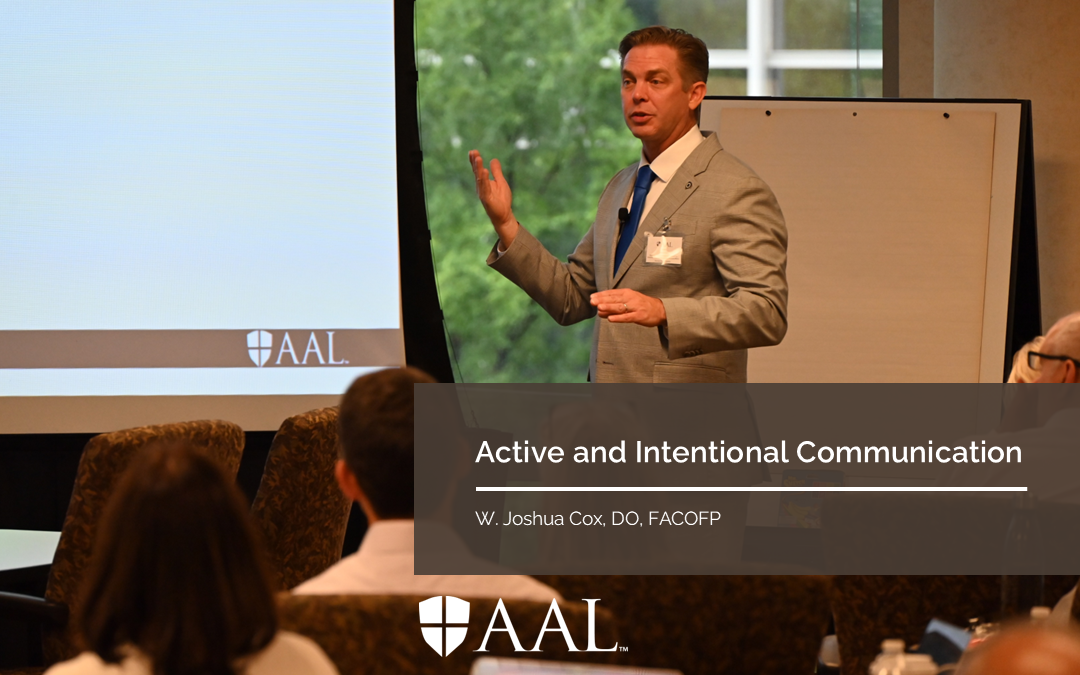
We expect leaders to find solutions to problems. When you make a statement or ask a question in a meeting, it’s interesting to watch and notice how many people stop listening and start composing their reply before you’ve even finished. That instinct isn’t necessarily a character flaw; it could reflect how they were trained. As I progressed along my path to becoming a dean, I realized that good and effective communication isn’t one skill. It’s a process with two halves to consider: how you receive information, and how you send or share it. Neglect either aspect and it could cost you, in trust, in time, or in a decision.
Receiving information.
The receiving portion is best accomplished through active listening. This is something much more specific than nodding and repeating words back. It’s about being present and listening to gather understanding – not listening just to respond and find an opportunity to insert your comments. Leaders often supervise team members across multiple disciplines they themselves were never trained in. So it’s important to set clear expectations that when team members present a problem, they also provide at least one example of a potential solution, since they’re usually the content expert on the matter in question. A leader’s job is often to help connect multiple pieces of a complex situation and identify the best path forward. That works best if they actively listen long enough and often enough. The receiving information portion of communication should be deliberate and requires commitment to lifelong learning. Ralph Nichols and Leonard Stevens made the same point nearly seventy years ago in their study of listening in organizations: most of us listen at a fraction of our capacity because we’re using the rest of our attention to plan what we’ll say next.1 Intentional communication is the deliberate refusal to let that happen — on either end of the conversation.
Sending/sharing information.
The sending/sharing information portion of communication should be just as intentional and deliberate, and it’s one leaders sometimes overlook, particularly when fatigue and/or emotion become involved. Two practices have consistently helped me with this piece of communication. First: when a written exchange turns into several back-and-forth emails and is going nowhere, schedule a touchpoint – a meeting, a video call or a phone call. Then, in follow-up to that interaction, close the loop with a short written summary of what was actually discussed and agreed to. I’ve watched two people leave the same meeting both certain it went well, and both convinced someone else owned the next step(s). A brief recap prevents that, and is an opportunity to summarize next steps, establish accountability, and identify action items with associated timelines. Second: when an exchange or interaction has an emotional charge, process and draft your response, but don’t send it.2 Sit with it, and depending on the urgency of the response or decision, sleep on it. Read it back as if you were the recipient. Decide what the goal of your response is, and if it doesn’t accomplish what you actually need it to, delete it and start over. One additional consideration with both of these practices is the audience: who should be involved and who shouldn’t? If this is a meeting, decide who should attend. If this is a written exchange, consider whether it’s a reply to an existing chain or a new exchange, and who it is appropriate to send to – a specific individual, small group, entire department, and finally when to “reply all” to a message versus when that is not the best approach.
These practices are not complicated, but both are easy to skip or overlook when we feel rushed and are not deliberate with our communication practices.
Another example of how I’ve seen trust being eroded through communication choices is when people approach a challenge or a difficult circumstance and choose to communicate by blaming others and/or gossiping instead of stepping back and looking at how we can pursue the challenge together. In fact, going back to active listening, gathering input from others, focusing on a shared mission/vision/values, and then sharing the information and decisions out from that perspective is more collaborative and will help build trust back. I’ve observed capable leaders create conflicts that didn’t need to exist at all through responsibility shifting. Ultimately that creates an “us” versus “them” environment. It may protect their popularity in the moment but could cost them authority, respect, and results in the end. When a decision or direction from your leader isn’t one you would have chosen yourself, take the time to actively listen to better understand concerns, then explain the “why” behind the decision and how it connects to something the team cares about – students, patients, community, or sustainability of the organization. That’s a very different message than “this is what we’re doing because I said so,” or “this is what we’re doing because they said so.” Both versions dodge the same responsibility: making the decision legible enough that people can actually stand behind it, instead of just standing beside you while it happens.
I certainly don’t believe I have mastered the art of how leaders should communicate. In fact, the day I believe I have is the day I should stop leading. Until then, I will continue with lifelong learning, and the standard I will hold myself to is simple: actively listen to understand before responding, and be strategic, intentional, and deliberate with sending and sharing information.
References
- Ralph G. Nichols and Leonard A. Stevens, “Listening to People,” Harvard Business Review, September 1957.
- Danziger E. How to respond to an upsetting email. Harvard Business Review. November 29, 2023. https://hbr.org/2023/11/how-to-respond-to-an-upsetting-email
Contact AAL to learn more about our programs and services.

Author:
Joshua Cox, DO, FACOFP
Dr. Cox is a consultant and faculty of AAL’s Institute for Teaching and Learning Advisory Council. Dr. Cox is the Executive Dean, College of Osteopathic Medicine, and Senior Vice President of Clinical Affairs, Kansas City University.
RECENT ARTICLES