
Founding a medical school means making a series of high-stakes decisions, sometimes with incomplete information. Additionally, there is money on the line and many stakeholders watching your every move. Good judgment under that kind of pressure rarely comes from cleverness in the moment. It comes from deciding well in advance which principles you will use to make decisions under pressure.
Know your Principles.
In 2019–20, before I arrived in Fayetteville, our pro forma assumed a charter class of 80 because it gave us financial room. Then I sat down with Don Maharty, our designated institutional official, who had experience from starting many residencies and fellowships. He raised an important concern: medical student rotations in some specialties, like pediatrics and family medicine, were becoming very difficult to find. This is a national problem that was evident before the pandemic with 84% of U.S. medical school deans already worried about the number of clerkship sites.1 Don told me, “I can make 80 work. But I can really make 64 work and guarantee them a great experience.”
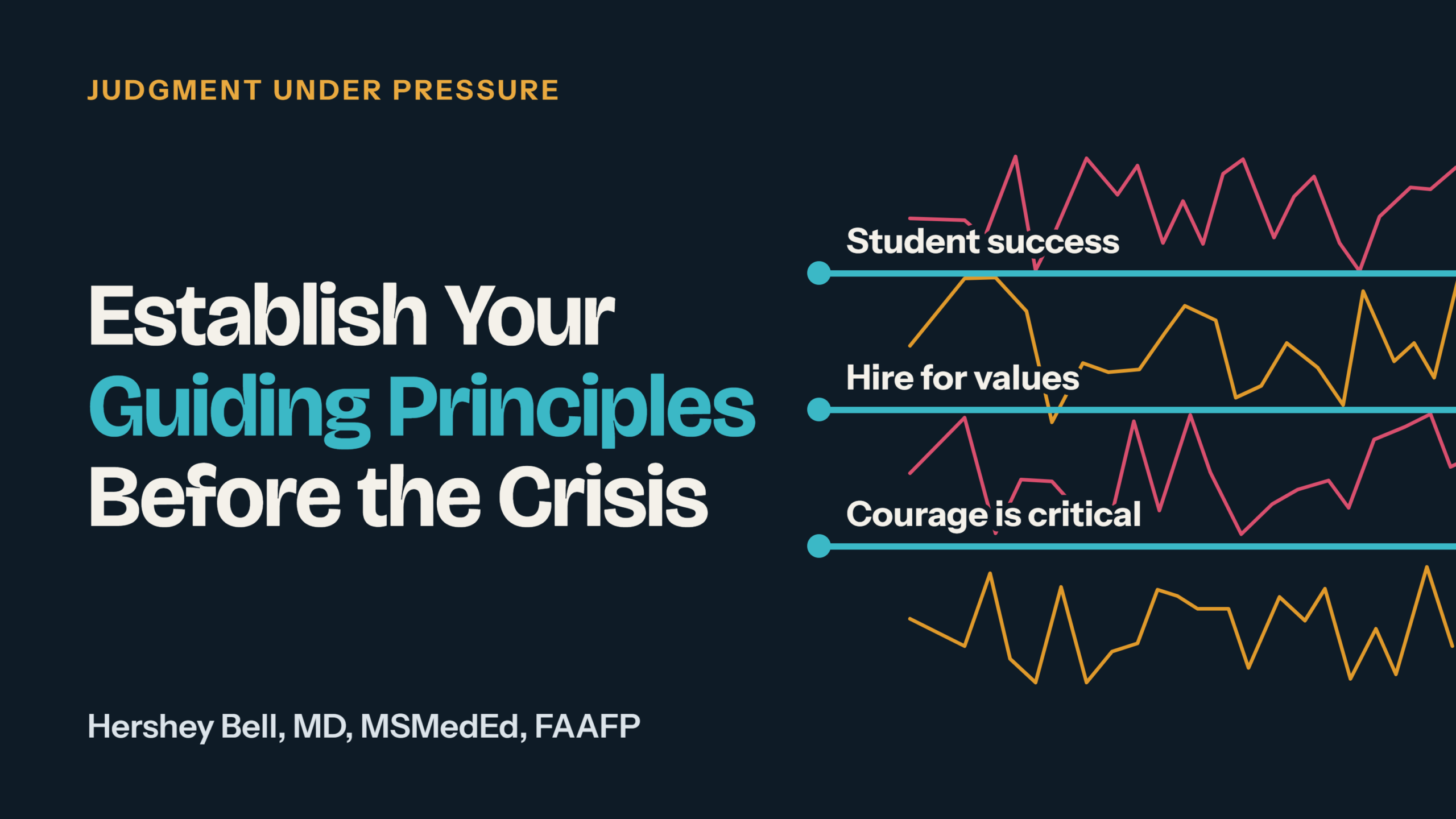
Going to 64 had financial implications for our organization because the fiscal planning had been based on 80 students. However, our driving principle had always been student success and when it came down to this difficult decision, we were able to lean on our predetermined guiding principle. Graduating 80 physicians is one possible outcome. But graduating 64 who had such a good experience that they want to practice here was an even better outcome to pursue. Our CEO, Mike Nagowski, agreed immediately and stated that “You only get one shot at opening a medical school. Do it right.”
Scholarship on decisions in turbulent environments report that having a few guidelines often work better than elaborate analysis when time and information are short.2 One of my personal guidelines is “Hire for values.” Over years of leadership and hiring I have learned that I can teach almost anyone how to do the job, however, I can’t teach empathy, professionalism or courage. Therefore, I prioritize hiring the person with exactly the right values even if they don’t have exactly the right skills or experiences.
Another important principle in my decision-making is that “Courage is critical.” At my institution, we aim to graduate physicians of competence, character, compassion and courage. Courage may, initially, sound abstract but it shows up in various behaviors. Speaking up for what you believe, taking a stand for the greater good rather than for yourself, accepting the consequences of your decisions, admitting when you were wrong, and starting again when the decision you made wasn’t right. Leaders who model those behaviors make it safe for dissenting voices and raising problems early,3 which is exactly when a leader under pressure most needs to hear them.
Know the parameters of the Decision.
Some decisions can be revisited and others cannot. Jeff Bezos calls them two-way and one-way doors, and he argues that the irreversible decisions deserve slow, careful judgment.4 The example of the inaugural class of a medical school is a one-way door. The class size, medical school and health system can grow but we can never have a second chance at our first class.
Pressure distorts judgment when we bring fear into the room. Fear can arise from real current threats like finances. However, some leaders carry fear from past decisions that didn’t turn out optimally. Others fear the future and worry “What if?” Savviness in decision-making is different. Being savvy may be summarized as practical wisdom: the ability to recognize one’s circumstances, anticipate potential risks, and select an appropriate course of action. Contrastingly, threat-rigidity effect is the research-established phenomena that, under threat, people and organizations narrow their attention and become less flexible which leads to more familiar and less creative responses.5 The antidote to this that I teach is being present. In a 1999 article in the Journal of the American Medical Association, Dr. Ronald Epstein described mindful practice as deliberate, non-anxious presence.6 Although the Epstein article focused on the clinician, self-aware decision making is also relevant to the leader.
Under pressure, you won’t invent your principles of decision-making. Instead, evidence shows you’ll fall back on familiar and sub-optimal thinking processes. Leaders must establish their principles before they are in a crisis so that they can effectively lead through a crisis.
References.
-
- Howley EK. So many medical students, so few clerkship sites. AAMC. September 10, 2020. Accessed October 29, 2026. https://www.aamc.org/news/so-many-medical-students-so-few-clerkship-sites
- Sull, D., & Eisenhardt, K. M. (2012). Simple rules for a complex world. Harvard Business Review, 90(9), 68–74.
- Murry AS, Badawy RL, Brouer R, Howard MC. Finding courage in psychologically unsafe environments: the impact of trait social courage and voice on leadership emergence. Am Bus Rev. 2025;28(2):343-360. doi:10.37625/abr.28.2.343-360.
- Bezos J. Decisions by Jeff Bezos. The Founders’ Published February 1, 2026. Accessed October 29, 2026. https://founderstribune.org/p/decisions-by-jeff-bezos
- Staw BM, Sandelands LE, Dutton JE. Threat-rigidity effects in organizational behavior: a multilevel analysis. Administrative Science Quarterly. 1981;26(4):501-524. doi:10.2307/2392337
- Epstein, R. M. (1999). Mindful practice. JAMA: Journal of the American Medical Association, 282(9), 833–839. https://doi.org/10.1001/jama.282.9.833
Contact AAL to learn more about our programs and services.

Author:
Hershey Bell, MD, MSMedEd, FAAFP
Dr. Bell is the Founding Dean at Methodist University College of Medicine. Dr. Bell is a Senior Consultant for The Academy for Advancing Leadership.
RECENT ARTICLES