
What do we mean when we say a person is an excellent leader? Depending on the context, excellent could mean a variety of things. Most people would say excellent leaders demonstrate knowledge and abilities that enable them to move others toward a shared goal or vision. Examples include understanding their fields and organizations, political savvy, and skills related to communication, negotiation, team building, mentoring, and decision-making, to name a few. This is a competency perspective on leadership. In addition to the competency perspective, excellent leadership is described in terms of the qualities or characteristics of the exemplary leader. From this perspective, characteristics often include integrity, courage, fairness, empathy, self-awareness, and humility, among others. This is a character perspective on leadership. Some overlap between the competency and character perspectives is common.
Competencies are amoral. Like instruments, they become good or bad based on how a person uses them. Communication skills can inspire, but they can also deceive. An effective negotiator can facilitate a mutually beneficial agreement, or exploit others for personal gain. The world is full of competent leaders who have the knowledge and skills to achieve outcomes, even spectacular results. Still, some lie, lack empathy for others, and champion hubris rather than humility. They lack the character that directs competency toward morally worthy ends.
Ethical Leadership
Character does not replace competency. We all know of people with impeccable character who were poor leaders, often because they lacked the competencies to do the job. The world needs competent leaders, but competence without character risks harming those it is supposed to serve. The Greek root of ethics, ethos, means character. Character is the fountainhead of a particular kind of leadership, ethical leadership, which recognizes leaders’ moral responsibility to use their authority for the common good. Not all leaders are ethical. Not all leaders care about the common good. Ethical leadership is a necessary condition for trust. It underpins transparent communication, effective interaction across teams and organizations, and stakeholder confidence. Ethical leadership rests on duty: what can rightly be demanded of the leader, and what invites blame when neglected. Honesty, fairness, truthfulness, and commitment to serve others are not heroic, but doing them reliably is too rare.
Most leaders consider themselves ethical, people of sound character, even as daily headlines attest to the weakness of human moral fiber. To suggest that someone should lead ethically will garner almost unanimous agreement. Or, as Machiavelli advised the prince, they should at least appear ethical. Returning to where we started, to the concept of excellence, I will argue in what follows that excellent leadership surpasses ethical leadership in important ways.
Going Beyond Duty
The word excel comes from the Latin excellere, to rise above, beyond, or surpass. Joanne Ciulla has observed that to call a leader “good” can mean effective or ethical, and that the two are not the same. Her two senses correspond roughly to the two perspectives above: competency makes a leader effective, and character makes a leader ethical. What would it mean for a leader to be morally excellent in a fuller sense: not merely competent, not merely of good character, but rising above?
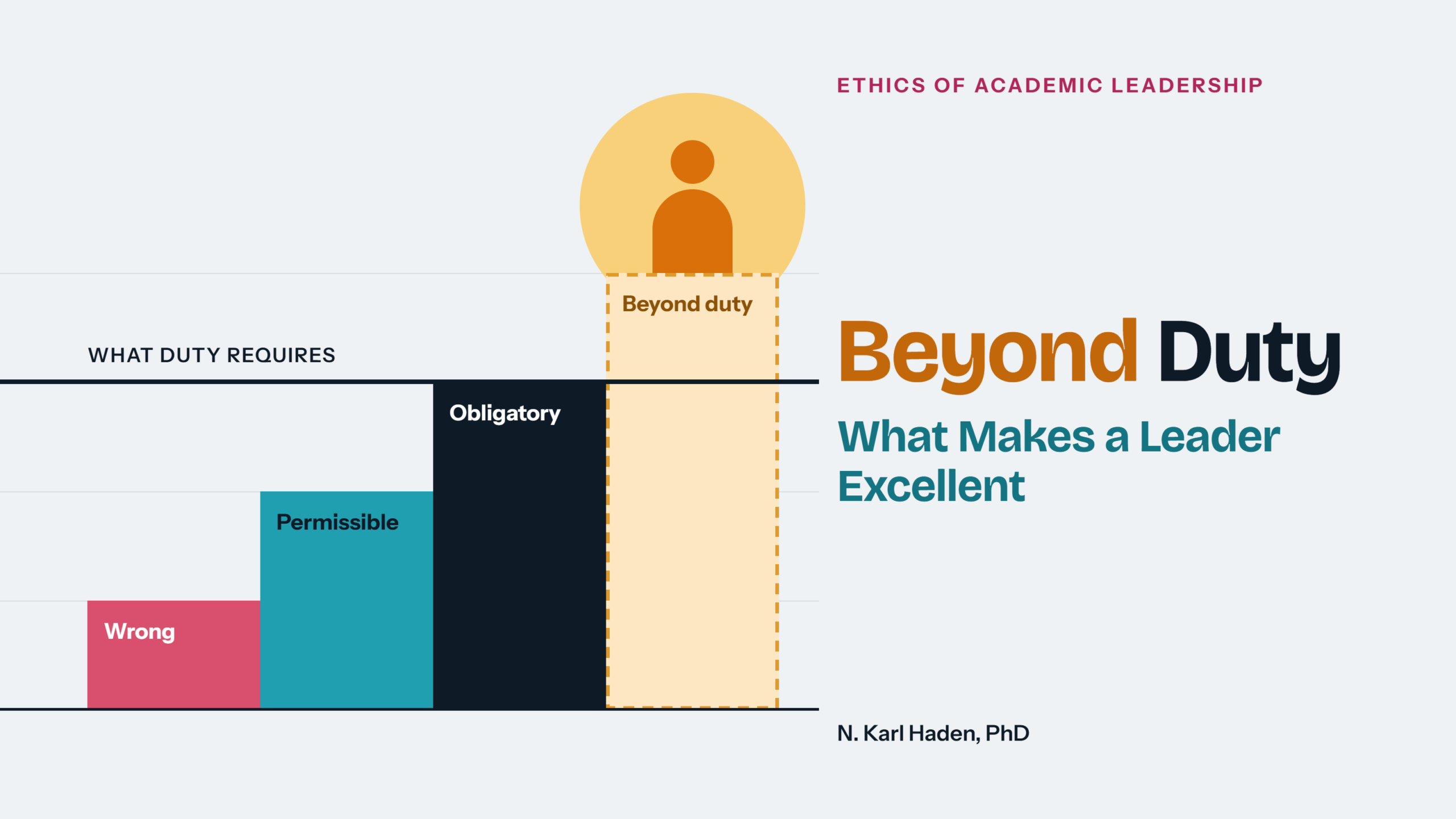
To answer this question, I draw from an influential and still relevant essay titled “Saints and Heroes” written by J. O. Urmson in 1958. Urmson observes that philosophers tend to assess the worth of moral actions in three distinct ways:
- Obligatory acts: Actions that are duties, that we ought to do (e.g., giving a struggling student honest feedback);
- Permissible acts: Actions that are permissible from a moral standpoint, but are not morally required of us (e.g., holding a faculty retreat off campus);
- Wrong acts: Actions, that we ought not to do (e.g., retaliating against a faculty member who expresses a difference of opinion)
According to Urmson, the trouble with this traditional tripartite view is that it is “totally inadequate to the facts of morality.” He uses the concepts of hero and saint to show what this classification leaves out.
For the purposes of this article, I will focus on Urmson’s hero, although his description of the saint includes almost identical considerations. In the sense that matters here, the hero accepts a risk or cost that no one could demand, and does far more than duty requires. Urmson’s examples of heroism include the physician, no differently situated from many other physicians in other places, who volunteers to join depleted medical personnel in a plague-ridden city or the soldier who throws himself on a grenade to save the lives of his comrades. In both examples, these actions are not obligatory; they go above and beyond what is obligatory, what you might expect a person to do.
If the examples above are benchmarks of excellent leadership, then Urmson has set a high bar indeed. Urmson writes that he uses the hero and the saint because they are conspicuous cases: they clearly show actions that lie outside the tripartite division. His heroes and saints are not unlike well-known leaders most consider paradigms, e.g., Nelson Mandela, Abraham Lincoln, Eleanor Roosevelt, and others who have modeled the way in their service of others. Yet Urmson insists that going beyond duty can be as modest as being “a little more generous, forbearing, helpful, or forgiving than fair dealing demands.” In an academic environment, that might mean vouching for a junior colleague at some risk to one’s own credibility, volunteering for the hard assignment that others could have been given, or extending forgiveness where fairness would not require it. No one could demand these things, and no one could be faulted for omitting them. They are, in Urmson’s phrase, what we can “merely hope for and receive with gratitude.”
What Leaders Owe, and What They Can Give
Competency makes a leader able. Character points that ability in the right direction. Ethical leadership is character at work. It is too rare, even though it underpins the trust every organization depends on. Excellent leaders are rarer still. They go further. They meet their obligations, and then they give more than anyone could ask.
Contact AAL to learn more about our programs and services.

Author:
N. Karl Haden, PhD
President, AAL
RECENT ARTICLES